John Lennon's sunglasses, Ringo Starr's ring part of Celebrity Auction at Mecum
John Lennon's "Lost Weekend" glasses & Ringo Starr's "Power Ring" will be at the Mecum Celebrity Items Auction
Mecum Auctions, known for its collector car auctions, has announced its first celebrityauction taking place in July in Santa Monica. More than 2,000 items will be featured in the Mecum Celebrity Items Auction including personal items and artifacts from Steve McQueen, John Lennon, Ringo Starr, Frank Sinatra, Marilyn Monroe, John Wayne, Hunter S. Thompson and more.
Two high-profile items from ex-members of The Beatles
were both consigned by their ex-girlfriends: A pair of John Lennon
prescription sunglasses worn by Lennon in the mid-70s during his 'Lost
Weekend' when he spent time with former girlfriend, May Pang; and a
custom-made ring worn by Ringo Starr that was given to him in 1976 by
his ex-girlfriend, Nancy Andrews.
Ringo can be seen wearing the silver and gold Electrum diamond
'Power' ring on the cover of his 1977 album, 'Ringo the 4th.' Both Pang
and Andrews will be at the auction to authenticate their items.
Steve McQueen fans will take note of his 'Yucatan' trunks (circa
1969-1971) which are also up for auction. The two trunks contain '16
leather-bound notebooks filled with drawings, storyboard illustrations,
photographs and a detailed story pitch' for 'Yucatan', a movie intended
to be the follow-up to McQueen's racing flick, 'Le Mans'. Although the
film star worked on developing the film for two years, 'Yucatan' never
got made. The film is currently in pre-production with Robert Downey Jr. in the lead role.
The bulk of the auction will feature items from the collection of
John Hagner, curator of the Hollywood Stuntman's Hall of Fame. Hagner's
extensive collection includes movie memorabilia from 'Indiana Jones and
the Last Crusade', 'Captain America' and other classic films.
Mecum Celebrity Items Auction: Celebrating the Legendary History will
take place at the Barker Hangar in Santa Monica, CA on July 26 and 27. A
silent auction featuring select items will begin online at www.MECUM.com on July 5.
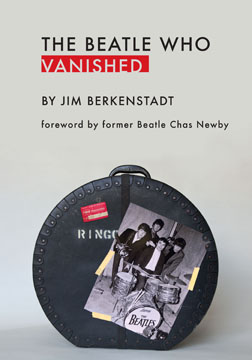
Whatever happened to Jimmie Nicol? Exclusive interview with author of new book, ‘The Beatle Who Vanished’
Published by Daytrippin.com
By Marshall Terrill
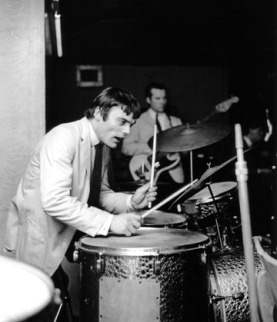
Jimmy
Nicol performing in London on the day it was announced that he was to
replace Ringo Starr for The Beatles World tour; photo courtesy Jim
Berkenstadt
Jimmie Nicol played with the world’s most famous rock group for 13
days…and then years later he walked out of his London flat and
disappeared without a trace. In his new book, “The Beatle Who Vanished”,
author Jim Berkenstadt uncovers the twisting trail of intrigue that has
followed Jimmie Nicol since his disappearance in the late sixties.
“The Beatle Who Vanished” is the first account of Jimmie Nicol, an
unknown drummer whose journey from humble beginnings to improbable
climb – rescuing The Beatles’ first world tour from disaster by stepping
in for an ailing Ringo Starr – was only part of his legend. Though his
13 days of fame made headlines, the true mystery of Nicol’s account is
riddled with blacklisting, betrayal, drug abuse, bankruptcy and an
eventual disappearance that leads many to question whether he is dead or
alive.
Berkenstadt, the author of several Beatles books, spent six years
of his life gum-shoeing the life of Nicol. In this exclusive interview
with Daytrippin’, Berkenstadt discusses why the Beatles selected Nicol,
his unforgettable 13-day tenure with the Fab Four, and how his 15
minutes of fame turned into nearly a five-decade hangover. Q:
As you so aptly state in the opening of the book, Jimmie Nicol was a
classy footnote in Beatles history. So what made you decide to dedicate
six years of research and writing to this project?
JB: “The Beatle Who Vanished” really started out as a challenge to
see if I could find enough information to write an article about Jimmie
Nicol’s life. He only ever merits one sentence in Beatles history books
and no mention in British music histories. I got lucky early on
finding out the general chronology of his career by locating bands he
had played in and then finding members of those bands to talk to me
about their lives with Jimmie. I found that almost universally his
friends loved him very much and found him to be generous and highly
talented. They all seemed to be rooting for him to succeed.
After a while, I was being connected to various band members from
Colin Hicks & His Cabin Boys to Vince Eager & the Quiet Three,
the Shubdubs and Spotnicks. This led to my compiling Nicol’s amazing
discography and helped piece together the chronology of his career. The
recordings I found all over the world, helped me to learn about Nicol’s
amazing and creative gift as a drummer, composer, arranger and producer.
The years of writing and research were an amazing journey and
challenge. Nicol was an enigmatic character. He always seemed to erase
his trail when he moved on, rather than preserve it. The best way to
describe my years of research is like a treasure hunt to find thousands
of pieces to a giant puzzle. Then after finding all the pieces, one has
to use interviews, photos, articles, video, recordings and memorabilia
(i.e. posters) to fit the pieces together to create the portrait of
Jimmie Nicol that readers will see in the book.
Q: You’ve been a part of the Beatles world for close to 25 years,
including working as a consultant on the reissue of “All Things Must
Pass” and the Traveling Wilburys box set. Not to mention your other
books (“Black Market Beatles: The Story Behind The Lost Recordings” and “The Beatles Digest”) on the Fab Four. How did this help in terms of locating sources for your research?
JB: The two projects you mentioned, along with some of my work for
Apple (The Beatles “Help!” DVD and the Cirque Du Soleil “Love” show)
involved treasure hunts and connecting with the right people who were
eyewitnesses to history. As an attorney, I became adept at research and
finding almost anything on the Internet. This would include locating
people who are hard to find, long lost news articles in foreign
languages and lost audio and video.
Q: Like most people, I have never given much thought to Jimmie Nicol.
Were you surprised by the fact that he was such an accomplished drummer
before he was asked by the Beatles to fill in for Ringo Starr?
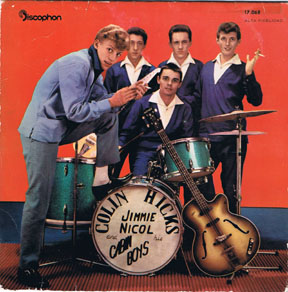
Colin Hicks and The Cabin Boys EP with Jimmie Nicol on drums; courtesy Jim Berkenstadt
JB:I did not know what to expect of Jimmie Nicol’s drumming
at first. It took about a year to locate some early 1950s live video
performances (which I will put up on my web site at www.thebeatlewhovanished.com)
and listening to 45s and LPs that I collected from all of the bands he
recorded with before and after his stint with The Beatles. Once I heard
the music he had played on, I was blown away by his ability to play not
only great rock and roll, but Ska, Big Band, Jazz, R&B and really
anything. As the readers will discover, not only was Jimmie a great rock
drummer who could step in at the last minute for Ringo, but through a
stroke of fate, he already knew the parts to The Beatles current concert
set list when they chose him.
Q: How would you compare Nicols’ style of drumming to Ringo Starr’s?
JB:It is interesting to use film clips of both Ringo and
Jimmie playing drums with The Beatles, to compare and contrast. The
Beatles were musically a very tight unit. They breathed, moved and
played together as one. Imagine how difficult it must have been for them
to launch a world tour with a brand new person to drive their rhythm?
Nicol came through for them based upon his experience.
From a technique standpoint, both Nicol and Starr employed the
matched-grip style of holding the sticks. This was still a new approach
to drum technique in 1964. The matched-grip approach positions the
weight of the arms over the stick, allowing the weight to assist in
producing a bigger sound. Briefly, Ringo’s style is defined by his
staying low to the drums and cymbals for the most part, using his
strong/powerful wrists to get a beat that is clear, communicative and
which helps define and serve key sections of the song. In contrast,
Nicol’s style is more staccato than Starr’s. Nicol employs more of a
whipping arm motion from a higher plane down into the drums which
produces a brighter tone (Nicol also sets his stool higher than Starr
for this purpose). His performances with The Beatles also highlight more
of his R&B and Big Band influences in the way he breaks away from
the beat and plays strong fills to set up changes in the tune.
Both styles work well to hold The Beatles together, yet of course;
Ringo had recorded the songs in his style, which would be more familiar
to fans. However, what fans could actually hear The Beatles at these concerts in 1964?!
Q: You cast a very large net when it came to researching Jimmie
Nicols’ life – including trips to England, Holland, and Mexico. I
imagine it was a surprise that this book took you around the world?
JB:Almost everything I came to learn about Jimmie Nicol’s
life was a surprise. He was the definition of an independent spirit. He
often chose the unexpected path. No one could tell him what to do or how
to think. Each time he vanished in his career, it would take me awhile
to locate where in the world he would show up next! He usually never
said goodbye… just walked out the door… to another spot on the globe.
Very mysterious. I tried to retrace his footsteps by traveling to
England, Sydney, Adelaide and Melbourne to get a feel for the places he
had lived and worked. I call that Frequent Flier Research…
Jimmie Nicol drumming for The Beatles in Adelaide, 1964; photo courtesy Jim Berkenstadt
Q: I was also surprised in your book by the amount of newspapers
articles that existed on Nichols in addition to some of the memorabilia
and photos you were able to unearth. How lucky were you in this regard?
JB: The articles were not too difficult to find. I would Google rock
historians in other countries who had an interest in their country’s
music history. They often had links that directed me to what I needed.
Google books were very helpful in locating “Billboard” magazine issues
mentioning Nicol. I collected the key British music magazines at EBay
in the UK.
Beatles historian Mark Lewisohn was very generous and helpful in
pointing me in certain directions and helping me find obscure facts.
Kudos to Mark! Many rare photos of Nicol with his various bands such as
Vince Eager, The Shubdubs and The Spotnicks were generously loaned to me
by band members.
The rare handbills, programs and memorabilia were found on EBay or
loaned from collectors worldwide. The Beatles era video and photos are
available to watch or license at archives such as Getty. I picked up a
set of Beatles autographs with Jimmie Nicol that was signed on their
first plane ride for a flight attendant on BEA at Sotheby’s Auctions in
1985. Priceless…. for $200. The first night concert set list from The
Beatles First World Tour, (illustrated in the book) was hand-written by
Neil Aspinall. He gave it to Lennon, who gave to Nicol, who used it on
his bass drum. After the show, Nicol left it. Torben, the drummer for
the warm up band The Hitmakers, picked it up as a souvenir and kept it
for decades.
LPs were the hardest to locate. I found a Mexican LP Nicol produced and played on in the late sixties called Nicolquinn.
It is the only copy in the world I have ever seen. Out of Nicol’s
10-page discography I compiled, I think there is only one 45 record I
was unable to locate; likely due to anemic sales at the time.
Q: What were some of the attributes Brian Epstein was looking for
when replacing Ringo Starr for the tour, and why do you think they
ultimately decided on Jimmie Nicol?
JB:This was an emotional and scary time for Epstein. He had
to find a fill-in for Ringo or the entire tour would collapse into a
disaster of financial ruin, lawsuits against NEMS and catastrophic bad
PR for The Beatles. There were no “out” clauses for illness to postpone
tours in 1964. The show must go on! Epstein needed a competent drummer
who could drive The Beatles bus while they could comfortably sing and
play the songs out front. But he also needed someone who was mature
enough not to let the experience go to his head. Maturity, diplomacy and
discretion were most needed to fill in. The person chosen would be
seeing and experiencing things on tour that did not fit into the current
“mop top” family-friendly image, such as sex and drugs.
There are other factors as to why and how Nicol was chosen, but I will leave those to be discovered by the readers.
Q: After the elation of The Call in which Nicol was notified that he would be touring with the Beatles, what sort of pressure do you imagine he was facing?
JB:By the time of The Call, Nicol was a pro. He had
played in some of England’s best first generation rock bands, led his
own big band and was one of the top 5 session drummers at the time in
London. He was a confident and strong player and in the book I explain
in detail how he already knew most of Ringo Starr’s drum parts. I think
he became nervous once all of the fan attention and media started to
surround him. He realized that this was no normal gig and no everyday
band. He had the stress of driving the best rock band in the world and
he wanted to do his job well.
Q: And conversely, it sounded as if Ringo Starr, though he shouldn’t
have been worried, was much more upset than originally reported. What do
you think he was going through?
JB: Ringo felt helpless in a hospital bed watching his buddies on TV
head off on their first world tour. Keep in mind, Pete Best had been
replaced by Ringo after only two years. Now Ringo was being temporarily
replaced (two years after Best) by Jimmie Nicol, a well-known London
drummer who was in the hottest live band in town, Georgie Fame and the
Blue Flames. He was likely a little insecure and worried…
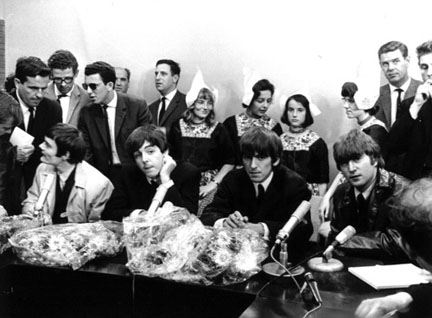
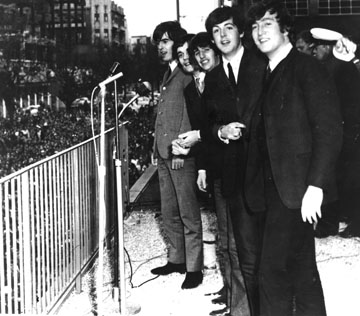
Jimmie Nicol (left) with Paul, George and John at a press conference in Amsterdam, June 1964; photo courtesy Jim Berkenstadt
Q: The most telling quote I found in the
book was when Nicol got his first taste of Beatlemania. He said: “The
day before I was a Beatle, not one girl would look me over. The day
after … they were dying just to get a touch of me. Strange and scary all
at once. It’s hard to describe the feeling but I can tell you it can go
to your head. I see why so many famous people kill themselves.” That
quote is in some ways a cautionary tale…
JB: This is a cautionary tale. In the words of Grammy Producer Butch
Vig (Paul McCartney, Nirvana, Green Day), “This is a fascinating and
mysterious must read for hardcore Beatles fans, and anyone who wants to
understand the meteoric rise to pop stardom and the subsequent crash
landing.”
Q: Despite all of the mayhem, it sounds like the Beatles burned the
candles at both ends during this tour and Nichol had to force himself to
keep up. Amsterdam, in particular, sounded like a wild time.
JB:The whole tour was pretty wild for its time, as readers
will see. Keep in mind, Nicol was a few years older than The Beatles and
he had done this all before. It is hard to come off stage after a
Beatles concert of wild, crazy screaming and simply go to sleep. So, a
good time was had by all.
Q: Nicol also endured subtle and not so subtle slights throughout the
tour, including a protest by an Australian DJ for not hiring a drummer
from Down Under. This must have put a few dents in his armor?
JB: Nicol was very independent and proud. He felt he deserved more
respect for his subbing and “saving” the tour from cancellation and
disaster. The Beatles were very friendly and respectful. They introduced
him at the shows too. But others were not so kind. Along the way,
managers of other bands would volunteer their drummer or a DJ would
protest the loss of jobs for their country. In addition, the posters and
programs all portrayed that Ringo was behind the kit – not Jimmie.
Surely this annoyed Nicol, who felt at times like he was
under-appreciated. I think over the years, these and other issues
revealed in the book, had an impact on his psyche.
Q: They say every picture tells a story, but that photo in your book
of Jimmie Nicol sitting alone in the Sydney Airport after his tenure was
over is haunting…it’s almost as if you can read his mind: “My life just
peaked.”
JB: That photo is quite haunting. Nicol is deep in thought. One day
you are on top of the entertainment world. The next day, you are on your
way home. What does the future hold? Can it ever be as amazing as what
you have just gone through? Can one ever go back to their everyday life?
What does 15 minutes of fame do to someone? I will leave it to readers
to see what Jimmie had to say about that amazing photo. I found it in
the archives of an Australian newspaper and licensed if for the book. In
my mind it had to be a full page, to convey its intensity.
Nicol performed the job admirably received a 500-pound bonus and a gold watch. I can’t help but feel that he felt hollow inside.
How he felt about The Beatles experience seemed to change over the
years. I don’t want to give away the story, but it is quite interesting
and mysterious.
Jimmie Nicol with all four Beatles in Melbourne; photo courtesy Jim Berkenstadt
Q: Thanks to your meticulous research, the Jimmie Nichol story
doesn’t end in 1964. Can you give readers a brief sketch of what he did
in the sixties, seventies and eighties?
JB: The research was intense. Over 700 footnotes. Hundreds of
interviews with his friends, bandmates and eyewitnesses. Before The
Beatles, Nicol played rock, jazz, big band, R&B and Ska in a number
of bands from the late 1950s to 1964. He then started to get involved in
recording sessions and arrangements. He created a pre-Beatles band
called Jimmie Nicol & the Shubdubs, which he also carried on with
later. Nicol rode a roller coaster of successes with different tours,
recording projects and non-musical occupations. He also had failures
along the way, including band breakups, bankruptcy, divorce and more.
Q: If there is a message or subtext to “The Beatle Who Vanished,” what would you like you to convey?
JB: I think this is an interesting story on two levels. First,
piecing together the career of someone who is really forgotten in
history is one part detective work and one part jigsaw puzzle assembly.
There were thousands of pieces to Nicol’s puzzle; especially because he
had the ability to vanish and move to another country. More
importantly, a portrait emerged about a very talented person who
experiences a huge ride to the top of the entertainment world – at a
very young age and for a very short time. I wanted to explore what those
15 minutes of fame were like and how it then affects the rest of their
life. Hopefully, I have been successful in conveying Nicol’s story,
which is clearly a cautionary tale.
Note: Visit the official website for “The Beatle Who Vanished” at www.thebeatlewhovanished.com
where you can read a free excerpt and watch the official video promo.
You can “friend” the author, Jim Berkenstadt on Facebook at http://www.facebook.com/RockAndRollDetective
**** Marshall Terrill is the author of 16 books. His next literary
endeavor will be a photo/passage book with guitarist Laurence Juber
called “Fifty Years on Six Strings.” It will be published in November
2013 by Dalton Watson Fine Books.
Producer Anthony J. Resta is not afraid of change.
He's weathered the decline of the big record labels, the rise of the home studio, the death of vinyl and CD, the birth of iTunes and Dropbox, and has adapted to a sea of change in an ever evolving industry that most critics say is on life support. However, the Massachusetts-based producer/writer/singer/soundscaper just rolls with the times and continues to come out on top.
In the conclusion of this epic five-part interview, Resta discusses his work with other radical and iconic artists and his big move to the West Coast as he gets ready to enter the world of film and television.
Part IV:
Q: Let's go through some of
the other highlights in your discography, which is quite extensive.
AR: The funny thing is I've
done a lot of stuff and what I have cobbled together isn't the entire
discography. I'll remember something or hear a piece of music and go, “Oh yeah.
I worked on this track” and will have to write it down and add it later on.
Happens all the time.
Q: Nuno Bettencourt is an
artist who you've known a long time. Your first professional collaboration was
on his record Schizophonic (A & M, 1996). Tell me about your
relationship.
AR: As you stated we've known
each other a long time. We're talking way back in Hanson, Massachusetts, when
Extreme was doing early demos with Bob St. John, years before they made it big.
He wasn't even signed at the time. We worked on a couple of local things back
then as well. He's just a phenomenal talent. We started collaborating and
sending each other cassette tapes – and “DATS” (digital audio cassette tapes)
.I would send him musical beds and stuff and he would just cut them up and
rearrange them. I co-wrote a bunch of the tracks on Schizophonic. He has
always been there for me. He's a special friend and a special collaborator. We
get along very well and I even co-produced his wife's (Suze DeMarchi) album,
“Telelove” for Sony. Suze is an incredible talent as well. We have a rare
chemistry and we'll always be working together on something. He's an A-list
session cat now and hopefully we'll write some things in the future as we have
done in the past. The last thing we did was in 2010 with “King of the Ladies” on the last Extreme album.
There's a very cool video to that song.
"King of the Ladies" by Extreme
I wrote the main riffs on a mad fuzz
bass sound. I was listening to a lot of “Cold Gin” by KISS at the time. We've
known each other twenty-plus years. He’s the godfather of my three-year-old
daughter as well.
Q: When you know someone
before they're famous and you come up through the ranks together, is there a
special bond that comes with that transition?
AR: I believe there is
because we've both been through many things together – ups and downs; the death
of parents; marriage; kids; watching each other's careers take off – so many
things. Yes, there's a bond along with a certain amount of pride. We just want
good things to happen for each other.
Q: Tell me about your time
with the Mudhens.
AR: They were a Boston-based
band I was close to when they first broke out. They toured with Neil Young and
a couple of other big-name acts in the nineties. They were very much ahead of
their time – earthy, organic, fantastic musicians and great songwriters. We did
a lot of music together… three records at least . I find myself listening to
them again now that they're on iTunes. They sold over thirty thousand physical
CD’s, which was no easy feat back then or now.
Q: You probably see acts like
the Mudhens who are extremely talented and yet never get that big hit or make
it mainstream while there are less talented acts who do.
AR: Yes, I see it all the
time and it's an equation that is impossible to figure out. There are so many
factors: marketing, being in the right place at the right time, strong public
relations, the right demographic targeting. It’s become a science of media manipulation
and expensive to do on a grand scale like the majors. We are all just
one viral explosion away from making an Internet splash. The thing is, back then it wasn’t like today where
the market is flooded with demos from artists looking to break it open. A lot
of kids today come up with some compelling with
believable recordings based on the technology that is offered. They may not be
sonically competitive with the studios who have big consoles but there are some
amazing things that come from those laptops and small pro-tools set ups.Some of my solo stuff tracks like “Love is a Twisted Melancholy Disease”
and “Cinematic Mojo”
were recorded and mixed on my
little G5 LE system.
"Love Is A Twisted Melancholy Disease" by Ajax Rayovac
The problem is the unfortunate downside. Too much music
with so much of it being almost unlistenable being the equivalent of a nine
billion gallon pool trying to flow though a pencil-sized pipe.
Q: Let's talk about working
with Blondie on “Pop Trash Movie”. She's a true icon from the 1970s.
AR: That was a very
interesting project. Nick Rhodes of Duran Duran had written that song specifically
for Debbie Harry. But the song was going to be for a project we were working on
called “TV Mania.”
"Pop Trash Movie" by Deborah Harry
That was a period when they were deep into samples of people
saying obsurd things…. which inspired the project. Anyway, we got a hold of
Debbie and met with her in New York City at the Hit Factory for about a week.
We came up with two tracks. The chemistry was great and we all got along
famously but the timing was off. She ended up getting a record deal shortly
thereafter and it was complicated with politics and paperwork. The one track
never saw the light of day but “Pop Trash Movie” ended up on the next Duran
Duran album. There was talk that the other song “Studio 54” was going to end up
in the movie Studio 54, but unfortunately it just didn't happen.Here’s Simon Lebon singing it live on VH1's
“Storytellers.”
"Pop Trash" by Duran Duran
Q: Since you brought up the
subject of politics and paperwork, I'm interested in hearing how that unfolds
when all you're doing is trying to make music.
AR: Anytime you start
playing with the big boys
there's eventually going to be contracts and negotiations that can get quite convoluted. You've got various
managers and lawyers looking out for their client’s interests or people might have a different vision for how a project
should come together. It might get to the point where it's too complicated or
difficult to work out.
Q: You mentioned “TV Mania”,
which is a project that's been sixteen years in the making. What is it about
and why has it taken so long to get off the ground?
AR: It's about the
absurdity of life through a TV that speaks. It was before we started seeing
reality television dominate the landscape. The concept is more of a stage presentation and it was visual in
nature. Unfortunately, everybody gets busy and things fall to the backburner.
But over the years, people kept hearing about it and asking when it was going
to see the light of day. I remember Duran Duran was actually playing stuff from
it on their tour before their set. Sonically it's a real interesting record
because we spent a lot of time on it.We'd use things like the Roland Sound Space machines (eight inputs and
outputs) that thing cost $40,000 and it made sounds appear as if they were
coming from above, below or behind you in the stereo field. The strange thing is that it sounds more
contemporary now than when we did it. It feels like performance art. Not too
long ago Nick listened to it again and thought it sounded fresh and that we
should do something with it and see what happens. He just felt that it was time
for it to see the light of day. I spent about six weeks at Bopnique augmenting
the tracks and then Bob St.John and I put the finishing touches on it at Sound
Techniques and Courtlen.
Q: I guess sort of like the
revitalization of Collective Soul's “Tremble For My Beloved.” I remember thinking that someway, somehow,
that song would get discovered. And thanks to Twilight, it eventually
happened but it took a good decade.
"Tremble For My Beloved" by Collective Soul
AR: Exactly, and that's the
case with “TV Mania.” It sounds even better today than it did 16 years ago. I guess we were on
to something in both instances.
Q: Elevator Drops?
AR: Great band from the
1990s. I worked with them on Demos, POP BUS 1995 and People
Mover. I thought they were one of the most cutting-edge bands ever. Check
out “Be A Lemonhead/Beautiful Junkie” on YouTube.com.
"Be A Lemonhead/Beautiful Junkie" by the Elevator Drops
They were great to work with.The way they worked influenced me greatly. I’m still collaborating with
Garvy J., one of the principle songwriters in the band. He’s also a great
producer.
Q: Tracy Bonham?
AR: Loved working with her. I
was doing A&R for A&M (Colorblind) back then. I heard the first demos
of “The One”, “Sunshine”, “Free” and some others. I freaked out and got them to
David Anderlie and Al Cafaro and before we knew it there was a bidding war (Paul and Josh Hager had produced these
amazing early versions).I was at the show down showcase at the knitting
factory in New York City. Chris Blackwell from Island was there and gave Tracy
a vintage Gretsch guitar. The rest is history. Last year we did a remake of
Duran Duran's “New Moon on Monday”.
It's crazy!
Tracy Bonham
She's one of my favorite female artists of all time. She's beyond
brilliant.We are talking about working
on another record together again, and I really hope we can.
Q: Tell me about Shawn
Mullins.
AR: I met him when he was
riding high on his first double platinum single, “Lullaby.” The label wanted a
follow up single, which was called “Shimmer” (Columbia, 1999). Peter Collins, who
was producing and has worked with everyone from Bon Jovi to Rush, Paul David
Hager and myself (thanks Paul) to work on it with him. Incidentally, I got to watch Peter work
on a number of projects subsequently and that was life-changing for me. I
consider him to be one of my mentors. I owe him a lot just for allowing me to
be in the same room with him and watch him work. But my first project with
Peter was Shawn, and we hit it off. I actually ended up helping him with his next album and
singleBeneath The Velvet Sun and “Everywhere I
Go” respectively.
"Everywhere I Go" by Shawn Mullins
It ended up being a phenomenal record, so much potential, but it never got the
proper push. It's a very cool sonic experience if you listen to it on a set of
headphones. It really wasn't what the label was looking for – they wanted
another “Lullaby.” Shawn and I are still friends and he's still out there doing
it.
Q: And this is a subject that
endlessly fascinates me – label interference. They want hit songs from the
artists but that is such a hard thing to demand. Art is art and whatever comes
out is the result. How do you do deal with the situation when a label says, “We
need you to produce hits.”
AR: They often listen to a
record and say, “GREAT” but we don’t hear a single. Then they spend more money
on a single than we spent making the entire record. It can be very frustrating.
But the reality is that you're working for them, so you have to pay attention
to what they're saying because they are the ones writing the check. It's
important to fulfill their vision, but you also have to fulfill the artist's
vision. It's definitely a sticky place to be sometimes. It can be stressful and
it was stressful on the Shawn Mullins album. Take for instance the song
“Valentine”; it was beautiful and futuristic and straight up pop. But at that time
we were making some pretty fearless music. The label allowed us the freedom to
make the music, but they wanted hits to sell the album. I think the album was
great but it just didn't connect the same way as “Lullaby” did.
Q: I'm surprised to see this
on your discography – Megadeth (Capitol, 2001).
AR: That was just a one-off
with the “Krushem” Jock Remix. They wanted a more aggressive, hi-tech version
for radio and clubs. Basically I re-cut the drums added a disco beat and some
bleeps and wiz bang type stuff. I heard Dave Mustaine hated it (laughs).
Despite that, it ended up being a pretty big theme for WFF wrestlers. Kathy
Anaya at Lippman Entertainment got us that one and we had a good time doing
it.I hear it all the time on sports
talk radio!Paul David Hager and Karyadi
stayed up with me for three days doing that on a long weekend in the middle of
another project. We were so tired. I can’t remember ever being that tired
since.
Q: Let's talk about the Scream
2 soundtrack. When you do songs for movies and soundtracks, is the approach
different?
AR: In my experience, a lot
of times it's an afterthought just like “She Said”
was for Scream 2.
"She Said" by Collective Soul
They
sometimes end up choosing something that's already been done. I'm just now
getting into situations where I'm actually composing music specifically for the
film.When you're looking at a movie and
you're creating music specifically for that project, it's a whole other world.
It's extremely exciting to me and I'm looking forward to going more in that
direction in the future. For Scream 3, we stripped it down and did new
drums, new guitars. That's why “She Said” sounds different on Dosage than
it does on Scream 2. It's a whole new treatment.
Q:Andrea Surova?
AR: Fabulous
songwriter/artist who was compared to Carol King in an article in the Boston
Globe by Steve Morris.She is one of
the best songstresses I’ve ever met. She should be writing megahits for
Mainstream artists like Diane Warren and Desmond Childs. I love her singing also. Truly an
undiscovered gem. We worked on two records together. On the first one we did
pre-production down in Nashville with a great collaborator and longtime session
guru Mike Lawler. Andrea paints musical pictures with songs like
“Silverhighway”. We have done quite a few co-writes as well.I love her music! Here is a great example: http://bopnique.com/andrea-surova-silver-highway
Q: John Cate?
AR: A Fab Americana/Roots/Pop
artist in a timeless classic style often compared to Bob Dylan and Tom Petty. I worked with him on Piece of This Town,
The Wondershow and X (ten). Those three albums that we did with him are
some of the best work I've ever been involved with. We have a great chemistry
and his band is just phenomenal.Listen to “California”
and that'll give you an idea of who he is as an artist.
"California" by John Cate
Q: Perry Farrell is one of
the more interesting people you've worked with. Tell me about that experience?
AR: I worked with him on Satellite
Party (Columbia/Sony, 2007). He's a pioneer of alternative music and is
always pushing boundaries and trying new things. That project had an enormous amount
of potential and I think it got perhaps a bit overblown. There had to be a
30-piece orchestra, multiple programmers, gospel singers, multiple
percussionists… I guess too many cooks can really spoil a soup. I prefer the
simple stripped down versions I worked on because there was so much more space
and for my ears it was much more beautiful that way. That album did bring Jim
Morrison back from the grave to sing on a couple of songs. The got these tapes
of him singing that no one had ever heard, sort of vocal poetry with melodic
moments. Somehow they got a hold of them and turned them into music. It was
another great opportunity that I owe to Nuno Bettencourt as he was co-producing
and got me involved.
Q: Donna Delory.
AR: She's often referred to as the “The Ethereal Girl” because she does
very spiritual world music with universal themes. She implements electronica
and has a strong connection to the yoga/meditation world. I'm working on her new album and have had
cuts on several of her records. We go back to around '96.
"Sky Is Open" by Donna Delory
Q: Her new record
really has an all-star cast including King Crimson bassist Tony Levin, who
played on John Lennon's “Double Fantasy.” How did you enjoy working with him?
AR: What Tony Levin does on
bass is like nothing I’ve ever heard. I must admit that I'm a huge King Crimson
fan, too. Listening to his tracks was freaking me out because his playing was
just so incredible.
"I'm Losing You" by John Lennon with Cheap Trick (with Tony Levin on bass)
Q: You recently worked with 17-year-old
Jarred Dylan from “The Voice.” How's that going?
AR: Even though he didn't win
the competition, I knew when I first heard him he was very special. He had this
delivery and persona that were right on the money. I see really big things
happening for him. I produced his first EP called In Panic and have
started on another one. There are several opportunities for him that are unfolding. Check out the song,
“Mistakes.”
"Mistakes" by Jared Dylan
It's a song I co-wrote with him and my buddy ORLECK (another fantastic Bopnique
artist). Check out his album Grey Suburban Day. Jared wrote the lyrics and
I performed the music. All of his material is very strong and I think we'll be hearing
more about him in the future.
Q: Even more recent than
Jared Dylan is your collaboration with Mark Farner of Grand Funk Railroad.
AR: We started talking on the
phone and he said, “Let's try a couple of songs and see what happens.” We had
chemistry on the first day and it was really special. I have to say this
upfront: as a kid I was a huge Grand Funk Railroad fan. At the time I had about
three albums in my collection and Live Album (Capitol, 1971) was one of
them. Mark Farner was just about the biggest rock star hero I could have
imagined at the time. Some of the new songs are really going to shock people.
He is 100 percent of what he was and then some. He's taken care of himself and
he's one of those gifted, soulful singers. Truly one of the greatest singers
I've ever heard. He hits the mark every time in tone and range. And he's just
so down to earth and cool, too. My little three-year-old daughter Milana’s
favorite song is “Rock and Roll Soul” and Mark busted into a vocal on that song
for my daughter one day at the studio. You should have seen the look on her face. I have a picture of it
and her jaw just dropped. Now she calls me up all the time and asks, “Is Mark
Farner at the studio?” (laughs).
Mark Farner, Anthony J. Resta and Milana Resta
The great thing about Mark, and I find this with a
lot of the veteran artists, is that they allow us the space to create.
Sometimes people with very little experience want to hold your hand and tell
you how to do everything. Then you get someone like Mark who gives you this
wide open space, and its just heaven…. it was a great way to collaborate. We connected on more than just a musical
level.
Let me just add this disclaimer: I've worked
with more than 300 artists and each and every one of them is special. I wish I
could talk about each and every one of them here but I know we just don't have
the space. I feel bad because it's hard not to mention so many of them.
Part IV:
Q: Let's
backtrack a bit and discuss the state of the music business. Your rise in the
industry was also at the same time as the rise of the home studio and the tail
end of the big music labels and studios.
AR: That's right.
It all happened around the same time. My studio became a very special place for
me and artists, and eventually it took on my personality. It's this old brick
warehouse and unlike any other studio you've ever seen before. In the beginning
it was just a place to store my stuff while I was off to Miami, New York,
London, wherever I worked. I really only used it for my solo stuff working as
Ajax Rayovac. Then when I fully acquired enough high end gear and got tired of
living in hotels and away from home for months at a time, I took a gamble on
this place and I've now been building it for 17 years. I work witha phenomenal engineer /mixer who's been with
me all this time. His name is Karyadi Sutedja and he is a musical mastermind.
Karyadi Sutedja working on a track at Bopinque!
Together we have crafted
the Bopnique Sound a worldwide brand. I couldn’t have done it without him and
we will continue on together when we move to LA to operate Bopnique West.The past few years have brought people from
all over the world to us; people who hear the details and the non-generic
fearless quality in even the simplest pop songs
Q: It definitely
seems cozy and homey with the couches and lighting, and of course, all the
toys. Do you feel artists are attracted to this setting?
AR: Its like
working in a giant living room. Of course! One artist said he loved coming to
my studio because he could come there every day and find something new he
hadn't seen before.
Bopnique's comfy digs resembles a living room disguised as a music studio
It's like a museum. Everyone seems to like the idea of
recording in one big room because everybody's on the same page. A lot of
studios have that glass between the artist and producer, and they can only talk
to each other through a button. It seems like such a cold approach to me. I've
abandoned that method and everybody here rolls up their sleeves and works
together. If something's not working, I'll pick up a guitar and say, “How about
this?” It's more of a team approach.
Working together in one big room at Bopnique
Q: Why do you
suppose there's been this movement towards home studios as opposed to the big
state of the art record studio that cuts records for the big labels?
AR: The easy
answer is that technology has become more and more affordable. High end digital
audio work stations are getting less expensive and so now it's possible for
artists to record really great music at a reasonable price. But at the end of
the day, it all boils down to is, “Is it a great song or not?” Take a song like
“Pumped Up Kicks” byFoster the People.
"Pumped Up Kicks" by Foster the People
It's a very homemade record and was beefed up in the
mix stage, but that just goes to show you that if a song is catchy, a hit is
achievable in a smaller studio. It's a smash no matter what. But the downside
to that is there's just so much more material for us to wade through, and a lot
of it is not good. It all has to start organically, and that's with a good
song.
Q: One of the
other movements I've noticed is file sharing where it's possible for someone to
record a vocal in New York and send the file to Los Angeles for a drummer to
lay down a track. That astounds me.
AR: It's very
commonplace today thanks to Dropbox.com, and yes, we do it. You can work with
anyone, anywhere at anytime.
Producer Anthony J. Resta works his magic on a musical track through Dropbox.com
Q: Do you lose
anything as a producer from not being in the same room as the artist?
AR: It's nice to
be in the same room as the artist but for me, when I do tracks and I'm all by
myself listening to the song without interruption or distractions, I can find
that magic moment in the song. When you're in the middle of a recording
session, it may or may not be that time to reflect, so file sharing definitely
has its advantages. In the end though working in the same room wins.
Q: Your newest
foray will be composing music for film and television, so let's discuss the
Bopnique West venture.
AR: For years I've heard from
various sources, including a lot of folks in the motion picture and television
industry, that my composing could be perfect for the medium.
A lot of my work has ended up in movies. “Out of My Mind” for instance by Duran
Duran was a track in the film The Saint.
"Out of My Mind" by Duran Duran
There's quite a list and more
and more opportunities seem to be springing up in that area. So many up and
coming indie film projects are under way. It’s a brave new world for me and the
scoring side is scary and exciting. I don't want to replace what I’ve been
doing for the past 17 years but there are so many other uses for the
“soundscaping” that has become my signature over time. There isn't the same
constraint as there is with a three-to-four minute pop song. I like the fact
that the music is supportive and secondary to the story and dialog. It’s not
about “the song” it’s about creating a mood than enhances but not distracts.
Q: Are we talking
writing songs for movies or scoring pictures?
AR: Actually both. I'm working on several projects including a solo record
with actor Michael Chiklis. He has a fantastic new primetime show called
“Vegas”. He's a very established actor, but he's also branching out as a
musician and it's super cool music and I think people will dig it.This track is called “The Connection.”
"The Connection" by Michael Chiklis
-->
-->
I’ve added drums, guitar and synth atmospheres on it. His longtime
collaborator Bob Pascarella is a monster guitar player/composer and as a team
we are really having fun creating.
Q: Do you ever get intimidated by the people you work with?
AR: Never intimidated but always a little scared...and I think that's
good. That little bit of fear in the pit of your stomach keeps you grounded and
also makes you work harder. The music industry is no different than the movie
industry in that if you make something that sucks or is not well received, it
travels far and deep, so you've always got to be on your toes. You have to
continue traveling down a path that's interesting and territory that's
unexplored. It's got to be a lifelong pursuit; otherwise, you grow stale as an
artist. So far that's one thing I've never been accused of.
For more information on Anthony J. Resta and Bopnique!, visit http://bopnique.com/
NASHVILLE, Tenn.— GRAMMY® Award-winning
former Beatles executive and music industry icon Ken Mansfield chronicles a
deeply personal journey of faith and struggle in his highly-anticipated fourth
title, Stumbling on Open Ground: Love,
God, Cancer, and Rock ‘n’ Roll (Thomas Nelson, January 15).
Revealing ongoing
trials with two bouts of cancer, Mansfield’s memoir thoughtfully frames his
spiritual struggle and physical pain in the light of ultimate healing and
triumph. Sharing personal prayers and honest insight alongside remarkable
moments from his storied music career, he confronts his failing body, a faith
that both falters and soars, and the questions that aren’t supposed to be
asked—but need to be answered.
Stumbling on Open Ground also features contributions from
Mansfield’s wife of 25-years, Connie. Offering a candid glimpse into a marriage
facing one of life’s greatest challenges, the couple trace the work of an
extraordinary God who has transformed them both in the process.
“Dealing with cancer is not as linear as
most books describe the ordeal,” Mansfield shares. “Going into it, going
through it, and coming out of cancer is not that orderly. The battle is more of
a hanging on, a falling apart, a sense of loss, and a lot of lonely flailing among
the rubble.”
“This is a quest
for deeper comprehension, a desire to dip beneath the opaque surface,” he adds.
“As a child, I would ask my earthly father how to do things. As a child of God,
I am asking my heavenly Father how this all works between Him and me.”
Ken Mansfield’s
legendary career in the music industry includes tenures as the U.S. manager of
the Beatles’ Apple Records, an executive at Capitol Records, a vice president
at MGM Records, and president of Andy Williams’ Barnaby Records (CBS Records),
among numerous influential roles. He has worked with such artists as the Beach
Boys, James Taylor, Roy Orbison, Glen Campbell and Lou Rawls.
Instrumental in
launching country music’s “Outlaw” movement in the 1970s, Mansfield was
involved in the careers of Waylon Jennings and Jessi Colter, among others. He
produced Colter's #1 hit "I'm Not Lisa," as well as Jennings’ 1975
landmark recording, Are You Ready For The
Country. He also produced the Gaither Vocal Band’s GRAMMY® Award-winning
1991 Homecoming album. The seminal
release precipitated the resurgence of Southern Gospel music and the Gaither Homecoming series of recordings,
videos and concerts.
Since devoting
his life to Christ more than two decades ago, Mansfield is now an ordained
minister and sought-after speaker. He appears at churches, special events and
colleges across the nation and has authored The
Beatles, The Bible and Bodega Bay (B&H); The White Book: The Beatles, the Bands, the Biz: An Insiders Look at an
Era (Thomas Nelson); and Between
Wyomings (Thomas Nelson).
Stumbling on Open Ground: Love, God,
Cancer, and Rock ‘n’ Roll
($15.99), a 256-page trade paper title, will be available January 15 from
Thomas Nelson.
Greg Hawkes is paying tribute to The Beatles almost 45 years after they enticed him to get into the music business.
The famed keyboardist and co-founder of The Cars, said everything musically begins and ends with the Fab Four.
“My first concert was seeing the Beatles in 1964,” Hawkes said. “They changed my life. Indeed, they changed the world.”
The release of The Beatles Uke (Solid Air Records, 2008), a cover of Hawkes’ favorite Beatles classics – is a timeless testament to the inspiration and influence of the legendary group’s music and on his career.
The 15-song collection of Beatles songs is played entirely on the ukulele and multi-tracked to create a “Ukesymphonic” orchestra.
Perhaps it’s not such a far-fetched idea after all when you consider that George Harrison, a known ukulele enthusiast, is considered the spiritual leader of the current wave of interest in the music. Fellow ex-Beatle Paul McCartney also plays the instrument, and compellingly so when he paid tribute to his fallen friend on “Something” during his 2002 world tour.
Hawkes, who helped define the sounds of the 1980s with his signature keyboard stylings on Cars hits such as “Just What I Needed,” “Let’s Go”, and “Shake It Up,” and “Heartbeat City,” took a new direction with his music in 2001 when his wife gave him a ukulele as a gift. He’s been hooked ever since.
Hawkes started collecting ukuleles and got involved in the “Uke” scene in and around Boston, which led him to try duplicating Beatles string parts. Longtime friend and former Cars guitarist, Elliot Easton, put Hawkes in touch with James Jensen of Solid Air Records, who suggested an entire CD of Beatles tunes. The result is The Beatles Uke.
“The ukulele has made playing music fun again,” Hawkes said.